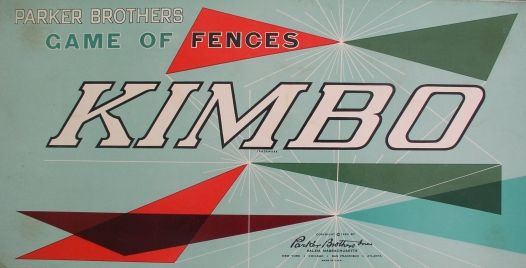
Published in 1960 (by Waddingtons/Parker Brothers), Kimbo, the Game of Fences is a game I found while browsing the 'Geek searching for games with my name (Kim) or nickname (Kimbo) in the title. (Oh tell me you haven't done the same thing!) When I found a game with same name as my BGG userid, I just had to have it! Luckily, a copy was available for sale on BGG itself and in a few days I was the proud owner of this "classic" (in my mind, anyway) game.
I pulled this game out for a try for the first time tonight and was pleasantly surprised by how good the game is. Even after 40+ years, the game holds up well against modern designs. Hardcore Euro-gamers will decry the use of dice and the "roll and move" mechanism but the game play itself is fun with interesting choices to make on each turn.
Kimbo is a simple game in concept. The board consists of an empty grid of squares. There is an enclosed area in the center of the board and an enclosed starting area at each corner of the board. Each square of the board is not bounded by a printed line, but by an indentation or slot in the board. Two to four players start the game with four pawns each, one of which is located in each corner of the board and six "fences", little plastic pieces that can be inserted into the board between a pair of squares. The object of the game is to get all four our your pawns into the center square by exact count. On his turn, a player may move one of his fences by inserting it into any unoccupied fence slot on the board. Then the player rolls two dice. The player can move one pawn the sum of the two dice or he can move two different pawns the value of each die. When a pawn moves it moves in a straight line. If the pawn runs into a fence or game border it can turn right or left and continuing moving. If a player rolls doubles, a players pawn can "jump" a fence as the only move for the turn (regardless of what kind of doubles were rolled). A player can move over his own or an opponents pawns with no penalty. Only a single pawn can occupy any square on the board, so a player cannot move onto his own pawns. If a players pawn lands on an opponents pawn by the exact count of one of the dice, the player can "bump" the opponents piece back to any starting corner.
After a few tentative turns, we got down to business. Fences were flying fast and furious and routes to the center victory area were being blocked. Then someone realized that instead of blocking an opponents piece, fences could also be used to "guide" ones own pieces into the victory area. I won the inaugural playing of my namesake game, but it was a close run thing. Three out of four players had three out of four pawns in the center victory area when I brought my fourth pawn home to win the game.
Kimbo is a game that is easy to teach and fun to play, with interesting decisions to make on each turn, showing that as far back as 1960 the concept of "Euro" style games was alive and well.