Saturday, December 31, 2005

Last Game Played of 2005

Sword of Rome was the last boardgame I played in 2005. I played the Greek player in a 3-player game. I managed to get out to an early lead that I was able to hold onto even though I ran out of steam in the 2nd half of the game.

The Gaul player is not played in the three player. Instead a roll is made each turn on the "Gaulish Ding Table" (as we named it) and one the three remaining players loses a CU or PC level. The table is based on 2D6 and the bulk of the rolls (that 5 - 9 range) will effect the Roman or Etruscan/Samnite player. In this game, the rolls tended to cluster around a particular player for a number of turns in a row. So the Greek player got hit early (with end of the bell curve rolls) and then the rolls started falling in the middle of the curve but always seeming to hit the same player for a few turns in row. Weird.

I would not recommend the 3-player version of Sword of Rome. Better to play 2-player than 3-player. 4-player, of course, is the best option.

The Roman player starts off the game in a tough position, but has the potential to grow strong as the game progresses. Charlie (playing Rome) didn't seem to see the potential of the Roman situation and got depressed early, going as far as to say that he won't be playing the game again... I think that's an over-reaction for a single play of the game and in fact his position was growing strong. I think he would have been able to challenge for the win, had we not called the game early due to time constraints.

This was my first play of Sword of Rome and I was favorably impressed. I may have been lucky in that the Greek position might be the best position to play when everyone is new to the game. The Gallic position might be another good position to play with inexperienced players.

I hope I can talk Charlie (and two other players) to give this game another chance.

Wednesday, December 28, 2005

I won! I won!

Well I'll be... I just won a copy of Empire of the Sun from The Dice Tower podcast and GMT Games. I'd like to take this opportunity to simply say "Thanks!" to The Dice Tower (Tom Vasel and Joe Steadman) and GMT Games. This is neat!

Empire of the Sun is a "card-driven" wargame covering the War in the Pacific during WW2. I've heard some very good things about this game. I'm looking forward to playing it.

Tuesday, December 27, 2005

Mall of Horror

Mall of Horror is the latest addition to my game collection (now at 812 if you're counting). I got the chance to play this game at BGG.CON and enjoyed the game (if not a couple of the other players) very much. Mall of Horror is a game with Zombies, but it is not about Zombies. It's all about survival and how you manipulate and back-stab the other players in the game to come out the winner. Make no mistake, the real "monsters" in this game are the players!

Other games recently added to my collection include:

Sunday, December 25, 2005

Happy Holidays!

I received a copy of Deflexion from my BGG Secret Santa. Deflexion is a game I've been meaning to add to my collection since the first time I heard about it. It's got lasers! It's an abstract game where each player, using mirrored pieces, tries to eliminate the enemy pieces by hitting them with an unreflected laser beam. I'm not talking about a "make believe" laser here, this is a real "Class 2" laser. The coolness factor for this game is off the chart! The game itself is not bad either, but without the lasers it would just be a run-of-the-mill abstract game. But with the lasers... Wow!

Regarding the BGG Secret Santa Project... This was a great idea. It was great to see so many BGG users respond and participate in the program. Tom Vasel organized the project and I think he was surprised at how many BGG users chose to participate. I expected a big turn out. I didn't have a specific number in mind, but I'm not surprised by the 200+ users that joined the project. I wouldn't have been surprised if twice as many users had participated.

Why was this "Secret Santa" project successful where other similar projects (in other walks of life) fail? Why was I willing to participate in this project and not the many others suggested this time of year? For me, it had everything to do with Gaming. I was giving someone a game they wanted and receiving a game I wanted. There was none of the "what should I get?" and "why did you get me that?" questions. Also, I have more in common with BGG users than I do with most of the people I work with or are acquainted with on a daily basis. For BGG, the success is due, I believe, to the spontaneity of the event. Tom proposed the idea late in the year, in December if fact, and the decision to participate was a "gut" reaction. BGG users just jumped on the bandwagon. If this project had been suggested and organized back in August or September, I don't think it would have been as successful. That would have allowed too much time for thought and too much time for the cynical nature of folks to surface.

There is a general assumption on BGG that there will be another BGG Secret Santa project in 2006. A lot of BGG users are looking forward to next year. I doubt that the 2006 program will be as successful as this year. I believe with a year to plan and organize the event, it will lose all of the spontaneity that made it such a success this year.

Saturday, December 24, 2005

A House Divided

Played For the People (GMT Games) for the first time today. It's one of the more complex "card-driven" game designs in that there are a number of special rules needed to keep the game more or less historical in nature. I'm not saying that this is a bad thing. Just that these special rules makes the game more complex and more rules "heavy" than most CDGs.

Charlie played the South and I the North. The first year of the war went well for the Union as all three neutral states were "persuaded" to remain part of the Union. The second year of the war didn't go as well for the North. After a successful raid that resulted in the destruction of Atlanta, the Union was forced onto the defensive as the quality of Southern generals made it difficult for the inferior Union generals to succeed in combat. A stalemate developed in the West and in the East General Lee and the mis-named "Army of the West" invaded the North and tried to take Washington D.C. Two battles were fought for Washington D.C. and both battles resulted in draws. The North retained control of the capital, but General Lee and the "Army of the West" remained active and posed to attack Washington D.C. a third time.

We ran out of time and we stopped playing at the end of 1862. Given the concentration of forces the South was able to put together in the East, I don't know that there is anything I could have done to avoid a battle for Washington D.C. Even if I had attempted to build a larger army in Gettysburg (the doorway to Washington D.C.), I think Lee would have rolled right over it anyway. In a future game, I think I would try and create a enclave/bridgehead somewhere in the Carolinas or Florida and build an Army there with the hope that such a threat, combined with offensive action in the west and a large "army in being" in Washington would divert the South's attention away from invading the North.

A good game. I'd like to play it again.

Sunday, December 18, 2005

Games Played: Family Fluxx

I know there are some gamers that do not like Fluxx, not even considering it a game in some extreme cases. But darn it, Fluxx can be a lot of fun and it's certainly one of the easiest games to teach and play that there is. Heck, the game only has one rule: "Draw One, Play One."

Family Fluxx is a new version of the original Fluxx. To quote from the Looney Labs web site: "Family Fluxx is the slimmed-down, brightened-up Fluxx. With simpler Rules, color Keepers, neat new family-oriented Bonuses for kids, parents and grandparents, it's fun for the whole family!" There are fewer cards in the Family Fluxx deck and most of the cards are new and have a "family" theme to them. It's a version of the game designed to appeal to a wider audience.

In addition to Fluxx and Family Fluxx, Looney Labs also publishes Stoner Fluxx and EcoFluxx. The rules are the same from version to version. Only the cards change with the "Keepers", "Goals", "Rules" and "Actions" changing to reflect the "flavor" of the version. The various Fluxx games are compatible with each other and can be combined into a single massive Fluxx game, although I personally prefer to keep each game separate as each game has its own "flavor." With the success of Fluxx, in all of its versions, it looks like Looney Labs have found their golden egg...

I decided to play this game because we didn't have a lot of time and I wanted something we could get into quickly and easily. It's hard to find another game that is as quick and easy to get into as any of the Fluxx family of games. As expected, the game went over well. Even non-game players will enjoy a game of Fluxx.

Not every game has to offer difficult choices and deep strategy to be fun. In fact not ever game has to offer anything in the way of choices or strategy to be fun. Anyone who claims that Fluxx is not a game just because it is too simple or too random or doesn't offer any choices is simply showing how limited they, themselves, are in their gaming options. They are showing themselves to be, in fact, gaming bigots.

Games Played: Hellas

The other game I got a chance to play for the first time was Hellas. I've heard a lot of good things about this game and I've been wanting to try it out. After three plays, I can see why the game is appreciated. It is an interesting mix of area control and card play. It has a "wargame" flavor but is easy to learn and play. I can see this game coming to table on a regular basis.

Hannibal Hits the Table!

I got the opportunity (finally!) to play Hannibal: Rome vs. Carthage yesterday. Wow. This game deserves its reputation!

We used my (up unitl now) unpunched copy of the game to play. I collect games, true, but I collect them to play, not as an investments or as display pieces. Getting an unpunched out-of-print game on eBay is nice, but only because it means the game is complete. Games are meant to be played.

By luck of the draw, I played Rome. After one play, I'm not prepared to knowledgably discuss the strategy of the game but I can say both sides feel like the other side is in the better position. For me, that's always a good sign.

Not knowing any better, I started off the game with an invasion of Africa and an attack on Carthage. That was a mistake and resulted in the destruction of the entire invasion force. Oops. This debacle was not as hard to recover from as I thought it might be. Rome is nothing if not resilient.

Fighting Hannibal without an overwhleming force or a good General (and both is better!) is a recipe for disaster. I managed to keep Hannibal out of Italy for the most part. Perhaps my opponent was simply not aggresive enough. I'm not sure what I would have done different had I been playing Hannibal, but I do come to the conclusion that the Carthagenian player cannot let Rome set the pace of the game. Hannibal and Carthage must take the battle to Rome and force Rome to react to Carthaginian moves. Give Rome the strategic inititive and time and perponderance of force will grind the Carthgenians down.

In the end Hannibal was killed in a battle in Northern Italy. Scipio Africanus was the victorious Roman general. At this point in the game, with three turns left, the my opponent was winning on points. With Hannibal gone and having lost a number of armies in other battles, my opponent felt the game was a lost cause and conceded. Personally, I'm still not sure a Roman victory was assured at this point, but maybe I'm too conservative to see the obvious. I think Rome would have won, but I don't believe it was a guaranteed victory. The loss of Hannibal, do doubt, is a hard blow to the Carthagenian hopes for victory.

Hannibal: Rome vs. Carthage is a "card driven" wargame. Card Driven Games (CDGs) are a relatively new addition (the first one, We the People was published just over ten years ago in 1994) to the wargaming family. I find I really enjoy the card driven games. Something about the card play adds something to these games that make them much more appealing to me than a "traditional" hex and chit boardgame. I haven't had the opportunity to play many of the card driven games yet, so I'm always looking for chances to play these games. They are just so much fun!

Sunday, December 11, 2005

Alternatives to Surrender

The First World War is a game I have been waiting over a year to get (in English). It is designed by Ted Racier and published by Phalanx Games. It is a "euro-wargame" and covers the war in Europe in a simple but interesting way that can be played to completion in a few hours.

The game board divides the map of Europe into three Theaters of War - the Western Theater, Italian Theater, and Eastern Theater. Each theater is sub-divided into two or more numbered Fronts. Each front contains the location of one or more victory cities. Ordinary victory city locations are shown with a box, color-coded to show the original owning faction. Replacement centers are shown by a circle in place of a box. Each front also contains one or more faction bases (hexagon shaped) which act as a special sort of city. Bases and cities within each Front are connected by Attack Lines which indicate which cities may be attacked. Finally each Front lists which armies may be deployed or moved there. The addition of blank "dummy" armies adds a "fog of war" element to the game.

One potential problem I have with the game are the "sudden death" surrender rules. It is possible (and very likely in my experience) that the game will end suddenly when one side fails a surrender roll (often a 1/6 chance). At first, I thought this "sudden death" surrender rule was an interesting idea. But after playing a number of games and every one of them ending due to a failed surrender role (even when the side rolling was in a good strategic position, i.e., "winning", otherwise), I began to feel that the surrender role hurt the game more than it helped. I like this game a lot, but I'm not a fan of the Surrender rules as written. There has been some discussion about this topic on ConsimWorld and a number of alternative ideas have been proposed:

  1. No Surrender in 1914 - this variant simply stipulates that there are no surrender rolls made in the first two turns of the game. Beginning in 1915, the normal surrender rules apply.
  2. Use a 10-sided die for Surrender rolls - Simply substitute a 10-sided die for the game's 6-sided die when making a Surrender roll. This will decrease the chances that a Surrender roll will fail.
  3. Opposing Surrender Points cancel out - In this variant, Opposing surrender points cancel each other out on a one-for-one basis. A Surrender roll only happens if one side has had a greater number of Surrender points imposed on itself than it has inflicted upon the opponent.
  4. Treat Surrender Points as "special" Victory Points - In this variant, the Surrender roll is done away with completely. Instead each time a Surrender Point would be scored (by an successful attack on a "Base", the side that got the Surrender Point would instead lose a Victory Point. In the game, victory points are won or lost each time a city changes hands. Victory Points lost when a Base is attacked, on the other hand, could never be regained because no city changes hands. The best a defender could do would be to push the attacker away from the Base, so additional victory points could not be lost.
  5. Treat Negative Victory Points as Surrender Points - Allow Victory Point totals to go negative and a faction's Surrender Point total is equal to that faction's number of negative victory points.

Obviously, some of these variant ideas are exclusive and some complimentary. #2 could be used anytime a Surrender roll was required. #5 could be used alone or in conjunction with #4. Alternatives #3 and #4 are mutually exclusive.

I have not had the opportunity to experiment with all of this alternatives yet, but I'm leaning toward using #4 in my next game. My only concern is that #4 does away with the Surrender roll entirely and I'm not sure that's a good thing. But I'd like to try it out and see how the game plays. Otherwise, I think option #3 looks interesting. Surrender is still possible under this alternative but less likely and the side with a Surrender Point can do something to mitigate the disadvantage, namely inflict a canceling Surrender Point on the opponent.

The First World War appeals to me on a number of levels. It covers a topic of history I have interest in and it scratches my wargame itch. At the same time the game isn't overly complicated and doesn't take a long time to play. It's a good example of a "euro-wargame."

Bits & Pieces . . .

New games this week: Sword of Rome and Dagger Thrusts.

Sword of Rome is a member of the "card driven" wargame (CDG) family and published by GMT. It's been on my "to get" list forever but now that "stock is low" and the game is likely to soon be out of print, it was time to pick it up. The game has pretty good buzz and it is a CDG (and I like CDGs...), so I'm hoping to get a chance to play it soon.

Dagger Thrusts is the latest S&T game (#233) and examines the potential Allied offensive plans in September of 1944. Montgomery's army could drive straight across the Rhine and into the Ruhr or try to outflank the German fortified defensive line and cross the Rhine at Arnhem. The other possibility was to let Patton attack towards Metz and swing North into the Ruhr valley. Historically, the decision was made to try the outflanking attack and take Arnhem with operation Market-Garden. In this game, players can see "what might have been" if one of the other attack options had been chosen.

I played a handful of games this week: Circus Flohcati, Poison and Bang! are lunchtime favorites at work. I also played Kimbo, Havoc: The Hundred Years War, San Juan, Arkham Horror, Trans America and Basari.

Monday, December 05, 2005

Game #800 -- A Milestone, of sorts...

Carrier Air Group by Dan Verssen Games becomes the 800th title in my game collection.

Carrier Air Group is an expansion for Hornet Leader II and adds new aircraft, including F-14 Tomcats and A-6 Intruders, new weapons (Phoenix missiles) and two new campaigns to the base game.

Carrier Air Group is the latest game in the popular "Leader" series of games that started with Hornet Leader and Thunderbolt/Apache Leader (both published by GMT Games and currently out of print). In 2005 Dan Verssen refreshed the line with Hornet Leader II, a new streamlined version of the original game. HLII was followed by Corsair Leader (bringing the "Leader" series to the Pacific in WWII) and the HLII expansion, Carrier Air Group.

The "Leader" system is a solo system in which the player simulates the operational and planning aspects of an air strike. The player, in the guise of a wing or squadron commander is given a mission and then must decided what mix of aircraft, pilots and weapons will have the best chance of success. The strike itself is carried out in a programmed series of steps complete with random events that may effect the mission outcome. As with many good solo wargames, the player soon becomes invested in the pilots in the squadron as each pilot begins to take on a personality of his own. Some pilots are lucky and get all the breaks. Some pilots can't hit the broadside of a barn with a radar guided missle and other pilots seem to attract enemy bandits and SAMs. As a campaign progresses and losses begin to mount, the tension builds as it becomes harder and harder to outfit each strike with effective aircraft and pilots.

With the latest games in the "Leader" series, starting with Hornet Leader II, Dan Verssen is also exploring new methods of game publication and distribution. The games are published by Dan Verssen Games and are available in VASSAL and PDF versions. No printed, boxed, retail version of these games currently exist. The PDF version can be printed (and counters mounted) by talented "do-it-yourselfers" to create a physical version of the game complete with cards and counters. The VASSAL version of the game allows one to play the game on a computer virtually anywhere without the need for paper maps, cards, counters or dice. For a solo game, this is an ideal situation.

The lack of a box and retail package is bound to hurt sales, but on the other hand, the price of the game is far lower than a retail version could hope to be. For folks familiar with the game system the price is hard to beat. For anyone interested in a solo game covering modern day air operations, the price is low enough to take a chance on.

Sunday, December 04, 2005

BGN - The New Kid on the Block

Boardgame News is the new boardgaming kid on the block. Rick Thornquist is back with boardgame news and "Gone Cardboard." This is a good thing.

When Rick announced he was quitting GameWire and Gone Cardboard, the boardgaming community lost a valuble resource. Rick's coverage of the boardgaming scene in a professional journalistic style is unique and sorely missed when it was gone. It's wonderful that Rick is back on the job.

The new web site is very impressive. The presentation is very nice with news bits and columns mixed together in a chronological order. Sort of like a blog on steroids. I'm impressed with the line up of columnists and look forward to reading the latest column each day. I hope the columnists can keep up a regular and steady flow of columns on a week by week basis. The news factoids are welcome and interesting.

I subscribed to the site on the very first day of operation because I want to support this kind of endeavor. When Rick quit Gamefest, there was an almost spontaneous offer of support. I said I would pay for the type of content Rick offers and I've put my money where my mouth is. I hope everyone else who said they would be willing to support Rick's efforts with $$$ will do so.

After about a week of operation, I can say that I'm very pleased with the results and do not regret spending my money on a subscription.

There has been some discussion on BoardGameGeek about the new site. Some folks have fallen into the "There Can Be Only One" trap and wonder why Rick started up a new site rather than add his content to BGG. BoardGameGeek and Boardgame News are not competitors. They are complimentary sites. Boardgame News is no more a "threat" to BoardGameGeek than Gamefest's Gamewire was. In fact, Boardgame News is simply Gamewire reborn.

I blame Tom Vasel for BGG vs. BGN controversy. It was Tom's comments, both on the new site and on his podcast The Dice Tower that started off the controversy. Tom announced he was moving his "Musings On..." series of articles to Boardgame News exclusively and that he was proud and excited to be part of a "quality" boardgaming web site. In Tom's defense, he probably had no idea what a firestorm his comments would start. I don't think Tom meant to impugn the reputation of BoardGameGeek, but that was the way many readers (and listeners) took his comments.

When I say that I "blame" Tom Vasel for the controversy, I say that in the a light-hearted way. I'm not pointing a finger of blame at Tom. I'm simply pointing out where the fire started, in my opinon. As always this kind of discussion is all "sound and fury, signifying nothing."

I welcome Boardgame News, as does most of the boardgaming community.

Friday, December 02, 2005

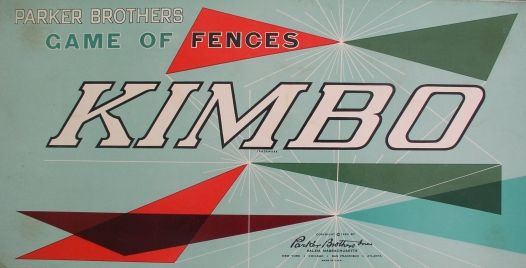
Kimbo - Game of Fences

Published in 1960 (by Waddingtons/Parker Brothers), Kimbo, the Game of Fences is a game I found while browsing the 'Geek searching for games with my name (Kim) or nickname (Kimbo) in the title. (Oh tell me you haven't done the same thing!) When I found a game with same name as my BGG userid, I just had to have it! Luckily, a copy was available for sale on BGG itself and in a few days I was the proud owner of this "classic" (in my mind, anyway) game.

I pulled this game out for a try for the first time tonight and was pleasantly surprised by how good the game is. Even after 40+ years, the game holds up well against modern designs. Hardcore Euro-gamers will decry the use of dice and the "roll and move" mechanism but the game play itself is fun with interesting choices to make on each turn.

Kimbo is a simple game in concept. The board consists of an empty grid of squares. There is an enclosed area in the center of the board and an enclosed starting area at each corner of the board. Each square of the board is not bounded by a printed line, but by an indentation or slot in the board. Two to four players start the game with four pawns each, one of which is located in each corner of the board and six "fences", little plastic pieces that can be inserted into the board between a pair of squares. The object of the game is to get all four our your pawns into the center square by exact count. On his turn, a player may move one of his fences by inserting it into any unoccupied fence slot on the board. Then the player rolls two dice. The player can move one pawn the sum of the two dice or he can move two different pawns the value of each die. When a pawn moves it moves in a straight line. If the pawn runs into a fence or game border it can turn right or left and continuing moving. If a player rolls doubles, a players pawn can "jump" a fence as the only move for the turn (regardless of what kind of doubles were rolled). A player can move over his own or an opponents pawns with no penalty. Only a single pawn can occupy any square on the board, so a player cannot move onto his own pawns. If a players pawn lands on an opponents pawn by the exact count of one of the dice, the player can "bump" the opponents piece back to any starting corner.

After a few tentative turns, we got down to business. Fences were flying fast and furious and routes to the center victory area were being blocked. Then someone realized that instead of blocking an opponents piece, fences could also be used to "guide" ones own pieces into the victory area. I won the inaugural playing of my namesake game, but it was a close run thing. Three out of four players had three out of four pawns in the center victory area when I brought my fourth pawn home to win the game.

Kimbo is a game that is easy to teach and fun to play, with interesting decisions to make on each turn, showing that as far back as 1960 the concept of "Euro" style games was alive and well.

Thursday, December 01, 2005

Soda or Pop?

(Lifted this from Joe Steadman's blog.)

I just find this very interesting. I have been under the assumption that that "Soda" vs. "Pop" Controversy was an West/East thing. But it looks like it's not that simple. Very interesting...

Tuesday, November 29, 2005

Top 20 Geek Novels

The ones I have read are in bold...
  1. The HitchHiker's Guide to the Galaxy -- Douglas Adams
  2. Nineteen Eighty-Four -- George Orwell
  3. Brave New World -- Aldous Huxley
  4. Do Androids Dream of Electric Sheep? -- Philip Dick
  5. Neuromancer -- William Gibson
  6. Dune -- Frank Herbert
  7. I, Robot -- Isaac Asimov
  8. Foundation -- Isaac Asimov
  9. The Colour of Magic -- Terry Pratchett
  10. Microserfs -- Douglas Coupland
  11. Snow Crash -- Neal Stephenson
  12. Watchmen -- Alan Moore & Dave Gibbons
  13. Cryptonomicon -- Neal Stephenson
  14. Consider Phlebas -- Iain M Banks
  15. Stranger in a Strange Land -- Robert Heinlein
  16. The Man in the High Castle -- Philip K Dick
  17. American Gods -- Neil Gaiman
  18. The Diamond Age -- Neal Stephenson
  19. The Illuminatus! Trilogy -- Robert Shea & Robert Anton Wilson
  20. Trouble with Lichen - John Wyndham

Can you guess which two books on this list I haven't ever heard of before now?

Saturday, November 26, 2005

Fortress America!

Pulled out the "classic" Fortress America for a three player game last night. Earl played the SAU (the South American Union) while Keven commanded both the East and West coast invasions. I played the defending Americans.

The invasion proceeded as planned with the American forces being pushed back on all fronts. I concentrated on taking out enemy air assets whenever possible. It ended up being a very close game. To win, the invaders have to take and hold (through the end of the following American turn...) eighteen of thirty cities. On two occasions the invaders took their eigthteenth city only to lose it (or another city) to my counter-attacks. That was the hig-water mark of the invasion. After a turn or two where the game was in the balance, the tide turned and the American forces began pushing back the depleted invading forces in the east and south. At the point, the writing was on the wall and Kevin and Earl conceded defeat. A close game that took us about four hours to play to completion.

Monday, November 21, 2005

Matt's Gnat

A picture of a gnat taken with my USB Microscope (Digital Blue) at 200x magnification.  Posted by Picasa

Monday, October 24, 2005

Four Lost Battles & War in the Ice

Just purchased Four Lost Battles by Operational Studies Group.

Four Lost Battles is a return to the "quadrigame" format encompassing four battles (as individual games that can be linked together) in the autumn of 1813 resulting in the Battle of Leipzig. The game is an update of the classic NLB/NAL system, introducing Hidden Movement, Baggage Trains, Pontoon and Bridge Trains, and other rules from OSG's "Days" Series. Set at the same scale as Napoleon's Last Battles -480 meters per hex and one hour turns- the game retains the Command System of Commanders and Corps "Officers."

This is the first "traditional" (hex & counter) wargame to catch my attention in a long time. This looks like a very interesting game and I am looking forward to playing it sometime soon.

I also acquired a "previously owned" copy of SPI's War in the Ice from a seller on ConsimWorld. War in the Ice is a "stand-out" game for me from the heydey of SPI. Something about the game designed really appealed to me. That something was the logistical element of the game, where offensives across the Antartic had to be supported by the building of bases to support the advance. Nothing new, I'm sure, but somehow, in this game, it all came together for me. One of the those games I regret not buying when I had the chance. Finding an unpunched copy at a reasonable price is like an early Christmas present!

I financed the purchase of these games by selling some more of my Magic the Gathering cards on eBay.

Sunday, October 23, 2005

More New Games!

Friday was a very good day, new gamewise... On the way home after work I stopped by my FLGS, Viking Hobby. There I found the new re-print of RA. In addition to RA, I also picked up the latest issue of Strategy & Tactics magazine which includes the solitare game Catherine the Great. In my continuing search for card games of War, I looked for a copy of NUTS! As it turns out, Jessica had moved it to the sale section of the store so I was able to get the game for half-price. (This is only the South portion of the game. I'm still on the lookout for the North set of cards.)

Arrving home and checking the mail, I found that Flaschenteufel (The Bottle Imp) had arrived from Germany sooner than I expected. Also arriving sooner than expected was the first of two packages coming from Amazon.com. This one contained Medici and David and Goliath.

I visited my parents on Saturday (yesterday) and as usual I brought along a box of games. During the day we played Zilch (a dice game), Diamant and Walk the Dogs... Zilch is a family favorite that has attained the status of tradition. It's not my first choice of games to play, but we always have fun playing it. Diamant went over like a lead balloon. Maybe I didn't teach the game right or maybe Mom was expecting a game with more strategy. Either way, I was told to not bring Diamant back next time! (Too bad, it really is a light, fun game.) Finally we played Walk the Dogs which Mom really enjoys. It's a good fit for my family. It's a light strategy game that is simple to teach and fun to play.

Thursday, October 20, 2005

Havoc: The Hundred Years War

Received this game from Funagain Games yesterday. The production quality is very nice and the card art is interesting. I have a minor nit to pick about the box itself... If it's a card game, the box should hold a single deck of cards. Havoc (and many other card game boxes) require the deck to be split into parts (three stacks for Havoc) for storage. That's just a hassle and a nuisance.

Can't say much about the game itself yet as I haven't had the the chance to play it. It's essentially a "climbing" game with an historical theme pasted on. I don't mean this in a bad way. I like that the historical theme has been added to the game, but the game mechanic itself is independent of the theme.

The rumors and comments that H:THYW is "poker-like" is based on the fact that a "battle" (hand/round/trick) is determined by who has the best hand of cards and the card sets are scored in poker-like fashion (straights, flushes, straight-flushes, full house, pairs, two pairs, etc.) The game is not poker and not a poker variant.

Wednesday, October 19, 2005

Bits & Pieces...

Got a link to the latest Lost Battalion Games newsletter... which I looked at and saw that there is a new supplement for the Sergeants! game... the supplement includes some new maps and a number of new scenarios for Sergeants!... so I had to have it of course... while I was at it, I also ordered a copy of Battlegroup, a card game of WWII Naval combat... As a free add-on to my order, I am also getting a copy of the $5 game Battleships in Action.

Looks like I will be bringing a demo copy of Winds of Plunder with me to BGG.CON. Tony Nardo, the developer of Winds of Plunder was fishing for someone to demo the game on ConsimWorld and I volunteered. I like the game and even though it has "made the cut" in GMT's P500 program, there's still a long way to go before it gets published. I'd like to play the game at BGG.CON multiple times and maybe get some buzz going about the game.

eBay continues to surprise me... I recently sold an opened copy of the Magic the Gathering Collectors Set for well over 10 times what I payed for it... The Collectors Set was a boxed set of the entire Beta printing of MtG. The cards were printed with square corners and "Collectors Set" printed on the card back so as to make the cards illegal for tournament play. For casual play however, using card protectors, the Collectors Set is a great way to get some of the original powerful MtG cards like Black Lotus and the Moxes... the money will come in handy too as it will help pay for my BGG.CON trip!

Games on order:

  • Medici
  • David and Goliath
  • Flaschenteufel
  • Havoc: The Hundred Years War
  • Boomtown
  • Ice Cream
  • Ole!
  • Sergeants! Scenarios Book 1
  • Battlegroup
  • Battleships in Action

Monday, October 17, 2005

New Games on the way . . .

  • Kimbo, "The Game of Fences" - my "namesake" game that I just had to have. Found a copy for sale on BGG.
  • Havoc - "Going fast" at Funagaingames.com and I didn't want to miss out on this game.
  • FLASCHENTEUFEL, The Bottle Imp - a fun trick-taking card game with a clever twist. A relatively unknown game that will be a welcome addition to my collection.

I got a few Amazon.com gift certificates for my brithday this year and so I went on a shopping spree:

  • Medici - Recommend by Mark Johnson, among others. Happy to finally add this game to my collection.
  • David and Goliath - A Tom Vasel recommendation. Looks like another interesting card game.
  • Boomtown - Another game I've been meaning to add to my collection.
  • Ice Cream - Impluse, spur of the moment buy.

Wednesday, October 12, 2005

Have Games, Will Travel - A New Podcast

Started listening to a new (for me, anyway) podcast entitled: Have Games, Will Travel. The show is hosted by Paul Tevis. The show splits its time between RPGs and Board games. Currently the Tuesday episodes focus on RPGs while the Friday episodes focus on board and card games. I no longer play RPGs (and that's a topic for blog entry all its own...) but I find the RPG episodes are interesting to a certain extent anyway. Paul's reveiws of boardgames are detailed and well presented, almost an audio explanation of how to play the game. The show lengths tend to be shorter, usually under 30 minutes and that's a nice change of pace. I would prefer less focus on RPGs, but Paul is primarily an RPG player, so we'll see how it goes. As long as the podcast keeps a balance between RPGs and Board games, I will continue to listen. I like Paul's style and look forward to future episodes.

Friday, September 30, 2005

I'm Going to BGG.CON in November!

It's been in the plans since March, but now that I've actually purchased the airfare, it's a done deal: I'm going to BGG.CON in November!

Friday, May 06, 2005

My Ten Favorite Games

A new audio show, "The Tom and Joe Audio Show" featuring Tom Vasal and Joe Steadman has hit the Internet "airwaves." Looks like Mark Johnson's hope that his podcast "Boardgames To-Go" could get something started in terms of boardgame related podcast/audio shows is bearing fruit.

As is my nature, this blog entry is in response to the topic covered by Tom & Joe. (I can't think up of topics on my own. Sad, I know...) In this case it's "Top Ten Games." Well, I don't really have a list of Top Ten Games I can name off the top of my head. But, since I have begun to rate games I've played on BoardGameGeek, I should be able to look at the games I 've rated there and assume that the ten higest rated games are "My Top Ten Games", right?

I currently do not have any games rated "10" on BGG. I'm a "bell curve" kind of guy, and the extremes make me uncomfortable. I haven't yet found a game that is so good, I'll give it a "10" rating. (At least, not for long. I have initially rated some games a "10" but after some thought, I've changed the rating to a lower number.) I have rated games "9" and "8", so that is where my list will come from. Since I have rated multiple games "9" or "8", I'm not going to stick my neck out and say "this is my #1 favorite game, this is my #2 favorite game, etc." Rather, I'm going to change things up and call this my "Ten Favorite Games" list.

The first four games on the list are games I have rated as a "9" on BGG. These are currently the "cream of the crop" as far as I'm concerned. The next six games in my "Ten Favorite Games" list come from among the games I have rated as "8" on BGG. At last I'm going to make a choice and choose six games from the 22 games I have rated an "8".

So, without further ado, here are "My Ten Favorite Games":
  • Memoir '44
  • Struggle of Empires
  • Ticket To Ride
  • Ticket To Ride: Europe
  • Age of Napoleon
  • Around the World in Eighty Days
  • Cosmic Encounter
  • Pirate's Cove
  • Twilight Imperium III
  • Blokus

I like all of these games very much. Don't ask me to put them in order from 1 - 10. That would be too difficult and subject to change from day to day.

Something I notice right away is the four out of the ten games are published by Days of Wonder. Is that because the games are new and look neat, or because the games are just really good? (I think it's because the games are really good. But maybe I'm just dazzled by the pretty bits.)

So that's it for now. I expect this list will change shortly, as soon as I've had the chance to play Arkham Horror (the new FFG version), Shadows Over Camelot (another Days of Wonder game) and Louis XIV.

Monday, May 02, 2005

A Brief Overview of my Personal Gaming History

The previous entry got a little long when I started talking about my personal gaming history, so I decided a separate entry discussing my gaming history would be best. So, without further ado, here is a brief history of my gaming life.

Gaming during the 60's - Ah, the lazy days of summer. I spent many the afternoon playing typical family style boardgames with friends. Games that come to mind include Monopoly, Payday, Mille Bornes, and the best of the bunch, Careers, among many others. This was also when I first played Milton Bradley's American Heritage series of games: Battle Cry, Dogfight, Hit the Beach and my personal favorite of the series, Broadside. These games are responsible for my life-long interesting in wargames and military history. To this day, I still consider Broadside one of my favorite games of all time.

Gaming during the 70's - High School, new friends and college. I met new friends in High School and this is when I really got into wargames in a big way. SPI and Avalon Hill were the the "Big Two" wargame publishers. GDW had a good reputation during this period as well. I subscribed to Strategy & Tactics magazine and together with a small circle of friends, played wargames. This was also when Dungeons & Dragons was first published and for the next two decades, RPGs took up a lot of my gaming time, at the expense of board games.

Gaming during the 80's - My brother's best friend was Mark. I met Mark at my brother's wedding where Mark was the best man. We found out that we both enjoyed boardgames (wargames, actually) as a hobby and began getting together one night a week to play games. We started out with wargames but over the years we eventually played a little bit of everything including RPGs, CCGs, Strategy Boardgames and even computer games. Along the way Roy joined our weekly event and the three of us played games almost every week for over twenty years.

Gaming during the early 90's- During the early 90's I got into Magic the Gathering (MtG) in a big way, starting with the Alpha version. For a couple of years my life (and finances!) were consumed by MtG. I never got into the tournament aspect of the game and eventually "fell out of love" with MtG when I realized the money pit would never end and I also realized I intensely disliked the never-ending rule disputes. I ended up selling most of my MtG stuff on eBay and probably making a small profit on the experience. I still play Magic casually today. I'll buy some pre-built decks from time to time and I have an account with Magic Online where I play every now and then. Magic Online solves the problems I had with rules disputes. Everyone plays by the same rules guaranteed. The problem I have with Magic Online is the same one I had with "Real World" Magic. Players take the game too seriously. It's hard to enjoy the game when your opponent is only interested in winning and trash talking along the way. Tournament level Magic the Gathering really brings out the worst in people.

Gaming during the late 90's - During the late 90's my gaming was limited to weekly game nights with Mark and Roy. During this period of time, we mostly played card games of one sort or another (Wizard, Phase 10, etc.). Sometimes we would branch out and try something new. I was usually the one to try and introduce a new game. The few Euro games I tried to introduce to the group never went over really well. I guess we were just stuck in a rut. To be honest, these game nights generally left me unsatisfied. I continued to meet and play games with Mark and Roy more out of habit and friendship than for any enjoyment I got from the games.

Gaming during the 00's - More of the same during the first few years of the new century. My interest in gaming was fading, due more, I suspect, to the unsatisfactory game night sessions with Mark and Roy, than for any other reason. This continued until 2003, when Mark unexpectedly passed away from Cancer. He was much too young. Game Night ended with Mark's death. Roy and I were never close friends. Mark was the glue that held the group together. With his death, I stopped playing games . . .

Hexwar.com and the Rebirth of my interest in Gaming - About a year later, a web site I had been keeping an eye on, Hexwar.com, finally went live and started offering Play By Internet games of classic SPI quad style wargames. These games, originally published in the 70's and 80's were simple games that were easy and quick to play. Hexwar.com offered a way to play these games over the Internet against opponents from around the world. The format was similar to Play by Mail, so both players could play when convenient, passing completed turns back and forth via the Hexwar.com servers. Having been a fan of wargames all my life, this idea piqued my interest.

When the beta version of Hexwar.com had gotten started back in 2002, I had set up a Yahoo Discussion Group dedicated to Hexwar.com. I did this to hopefully facilitate discussions of the games and to allow Hexwar.com players to arrange games. When the Hexwar.com site went live, in 2004, the discussion group became an integral part of Hexwar.com as subscribers of the service used the discussion group to discuss games, complain about bugs and look for challenges. The management of Hexwar.com also participated in the discussion group, using it to make announcements, and respond to subscriber questions and comments. Because I "owned" the discussion group, I became a Hexwar.com volunteer and active member of the Hexwar.com community.

Getting involved in playing games at Hexwar.com primed my game playing engine. By the fall of 2004, I had re-discovered BoardGameGeek (a site I had joined back in 2002) and re-discovered the wonderful world of strategy board games and my love of game playing. I spent the last months of 2004, digging my game collection out of storage and making up for lost time by buying over 100 games to add to my collection. I frequented eBay, where I bought out of print games from the 90's. I became a regular face at the local game stores and helped stimulate the local economy by buying many, many games. I traveled to gaming events in the Bay Area and found some new gaming partners in my local area. I attended a gaming convention (Conquest LA) in February 2005. Four days of non-stop gaming. It was heaven! I've started a local gaming group at work. Four or five of us get together every-other week. It's a small beginning, but successful so far. And I get to play games!

In 2005 my gaming is going full steam ahead. I've already attended one gaming convention this year (Conquest LA) and plan on attended KhublaCon in May, Conquest SF in September and BGG.CON in November.

So that's it. My gaming life in a nutshell. I'll bet I've played more games in the last few months than in the entire previous decade. My gaming life is good right now. Hope you enjoyed the tour.

Sunday, May 01, 2005

Family Gaming

Mark Johnson has recently turned his blog BOARDGAMES TO-GO into a podcast. The shows have so far been very interesting. I thought this might be a good time to start up my abortive blog efforts again. This time, instead of trying to come up with topics on my own, I'm going to take a que from Mark Johnson. I'll discuss whatever topic his latest show is built around. We'll see how this works out. So, for the first entry into this blog I will discuss Family Gaming.

Growing up, my family wasn't into playing family games much. Dad never showed any interest in playing games and we had to twist his arm to play a games like Monopoly with us kids. (In retrospect, that doesn't seem so strange any more...) My brother, five years older, didn't play "kids games" and after I started beating him at chess wouldn't play that game with me either. My sister... well, one just doesn't play board games with a little sister, does one?

I was the game player in my family. I played games all the time with my neighborhood friends. Monopoly, Careers, Life, Mille Bornes are the games I remember being played most often. I'm sure there were many others. Introduced to strategy type games when I found Milton Bradley's Battle Cry, Dogfight and Broadside (one of my life-long favorite games). Introduced to wargames when my brother received a copy of Avalon Hill's Waterloo for Christmas. Even though we were "too young", my friends and I taught ourselves to play games like Waterloo and Guadalcanel. Games like Broadside and Waterloo led to a life-long interest in wargames.

I'm still pretty much the only real gamer in the family . . .

My Wife, Theresa - doesn't usually play games, even when asked, except when we visit my relatives. This is very frustrating and she is a very good player when she does play. She Picks up on the rules and strategy quickly. It is a mystery to me why she doesn't play games more often.

My Stepson, Earl - Will play games, if I twist his arm, but doesn't seem to have the desire to play board games on a regular basis. Enjoys and plays video games constantly but only plays board games as "favor" to me. When he does play, he prefers games with a deep and obvious theme (Star Wars, etc.)

My Step Daughter, Jessica - Likes to play games but our personalities and lifestyles are so different as to preclude playing games together very often.

My Step Daughter, Amber - has no interest in playing board games. Will play only rarely and then usually only willing to play "party" games.

My Mom, Linda - Likes to play games and is willing to learn new games but often times has a hard time with a new game. Needs to play a game a couple of times before the rules start to sink in.

My Sister, Maggie - Enjoys playing games and almost always willing to play a game when our paths intersect, usually when I'm visiting my parents.

My Dad - Not a big game player. Plays cribbage and Zilch (a dice game). Almost always bows out when some other game comes to the table.

My Brother, Kevin - Not a big game player, as far as I know. Will join in a family game, but is rarely interested in the game, per se.

My Sister, Kathi - Never played games with my "little sister" (two years younger) very much. Will play "party" games, but shows no interest in strategy boardgames.